The Evolution of Canva AI: Enhancing Automated Design Workflows
The core promise of new AI platforms lies in their ability to understand user-described tasks, plan and execute them using relevant tools, and adapt to user preferences for future tasks. This is particularly significant for design professionals who seek predictable, automated workflows for creating content and media assets.
Canva's AI Assistant: Simplifying Design with Text Prompts
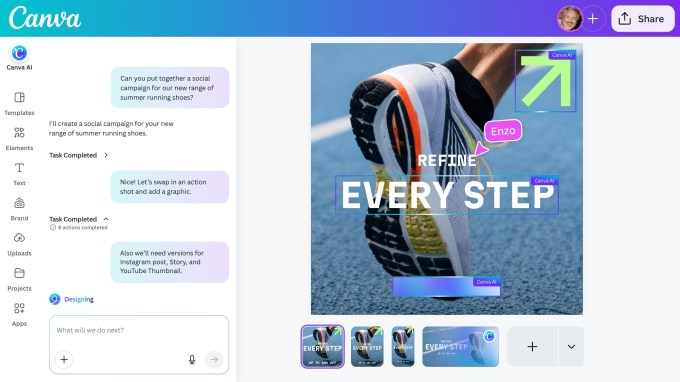
Canva has embraced this paradigm with the latest iteration of its AI assistant, enabling users to create editable designs through simple text prompts. Users can describe their desired outcome, and the AI assistant will utilize the appropriate tools to generate multiple design options. By leveraging layers in the design process, the platform provides users with the flexibility to adjust various aspects of the final product as needed.
This update represents Canva's commitment to positioning its AI assistant at the core of user workflows. It also introduces new features like image generation and website creation capabilities.
Competition in the AI Design Space
Canva’s competitors are also advancing in this space. This week, Adobe launched its Firefly AI assistant, capable of integrating with the company’s suite of apps to complete various tasks. Last month, Figma introduced AI agent support through its MCP server, further enhancing its platforms with AI-driven capabilities.
Canva’s Unique Strengths in Workflow Integration
Cliff Obrecht, Canva's co-founder and COO, highlighted the company’s edge in providing end-to-end solutions. “I think a lot of small businesses start and end their day, and they’ll do a lot of their workflows completely, in Canva,” Obrecht stated. He also emphasized Canva’s strong collaboration with companies like Anthropic, Google, and OpenAI, enabling seamless integration with agentic workflows while maintaining its strength in final-mile editing, collaboration, and deployment.
While Canva derives significant revenue from individual users and small teams, its enterprise business has demonstrated 100% year-on-year growth. Obrecht also mentioned that Canva, valued at $42 billion per PitchBook, is likely to go public next year.
New Integrations and Features
As part of its latest update, Canva introduced integrations with platforms such as Slack, Gmail, Google Drive, Calendar, and Zoom. These integrations allow users to grant the AI bot access to emails, conversations, files, and meeting data for building contextual awareness.
The update also includes a new web research skill, enabling the AI bot to browse the internet to perform designated tasks. Additionally, users can now leverage a scheduling feature for automating recurring tasks. Notably, this feature generates drafts for user review before posting.
Refinements to Existing AI Tools
Canva continues to enhance its AI capabilities. Its AI code generator now supports HTML imports, and users can utilize text prompts to create custom spreadsheets. The company also claims significant improvements in its AI models’ efficiency:
- The Lucid Origin image-generation model is now 5x faster and 30x cheaper.
- The 12V image-to-video model is 7x faster and 17x cheaper.
Launch of Canva AI 2.0
Canva AI 2.0 is launching in research preview this week. The company plans to roll out the updated version to all users in the coming weeks, marking another significant step in its journey to redefine automated design workflows.
If you're setting up a new PC, don't forget the software side. You can buy Canva Pro key at Whokeys.com — instant delivery, global activation, and full access to premium templates and AI design tools. A smart add-on for creators and small businesses.