No, Linux Desktop Market Share Has Not Crossed 10%, and Windows Isn't Losing Millions of Users
No, Linux desktop market share has not crossed 10% in North America, and Windows is not suddenly losing millions of users. 2026 is not the year of Linux for those who care. If anything, it’s the year the internet "died" because the entire spike appears to be driven by AI bots.
Almost every month, viral stories claim that Windows is losing market share and Linux is "eating it for breakfast." These claims often link to the same source, StatCounter, which is frequently misinterpreted.
For example, one of the most upvoted posts on Reddit’s Linux community and even Hacker News recently claimed that “Linux desktop market share has hit over 10% in North America.” The post included a screenshot showing Linux's supposed victory after years of struggle. However, the screenshot itself reveals glaring issues with the data:

The data lists Windows at 57.54%, ChromeOS at 2.06%, Linux at 10.65%, OS X at 21.14%, and macOS at 8.6%. The mention of "OS X" at 21.14%, despite being replaced by macOS in 2016, is a clear red flag. Even if we consider OS X and macOS as separate operating systems, it’s illogical for the decades-old OS X to have more users than macOS.
StatCounter Does Not Track Actual Windows or Linux Users
Is this really StatCounter’s fault? The answer is no. StatCounter was never designed to be the definitive baseline for desktop or mobile market share. For those unaware, StatCounter is an analytics platform used by web publishers and developers to monitor website traffic, akin to alternatives like Google Analytics.
Unlike Google Analytics, StatCounter publishes public “market share” reports monthly along with its methodology. According to StatCounter:
“Our stats are based on over 3 billion page views per month to over 1 million global websites – we are not aware of any other publicly available service providing market share stats that has a bigger sample size on which they base their information. We base our stats on page views (and not unique visitors) – we feel that this gives the fairest approximation of internet usage.”
StatCounter counts page views, not individual users or PCs. This means its data can be skewed by Linux-based agents or bots visiting websites with StatCounter’s tracking code, inflating Linux's numbers while reducing Windows' share (since the percentages are measured on a 100% scale). However, this does not reflect users transitioning from Windows to Linux.
Only MS or OEM partners can provide accurate data about how many people currently use Windows. According to MS, Windows 11 runs on 1.6 billion PCs, an increase from the 1.3 billion Windows 10 PCs reported in 2021.
StatCounter Has Reported Similar Anomalies
In July 2026, reports suggested that Windows' market share fell below 60%, supposedly losing 20 percentage points to Linux. This viral claim was based on June 2026 StatCounter data and was later corrected.
StatCounter has also mistakenly reported that Windows 7 was gaining users while Windows 11 was declining, leading to stories labeling Windows 11 as a failure:
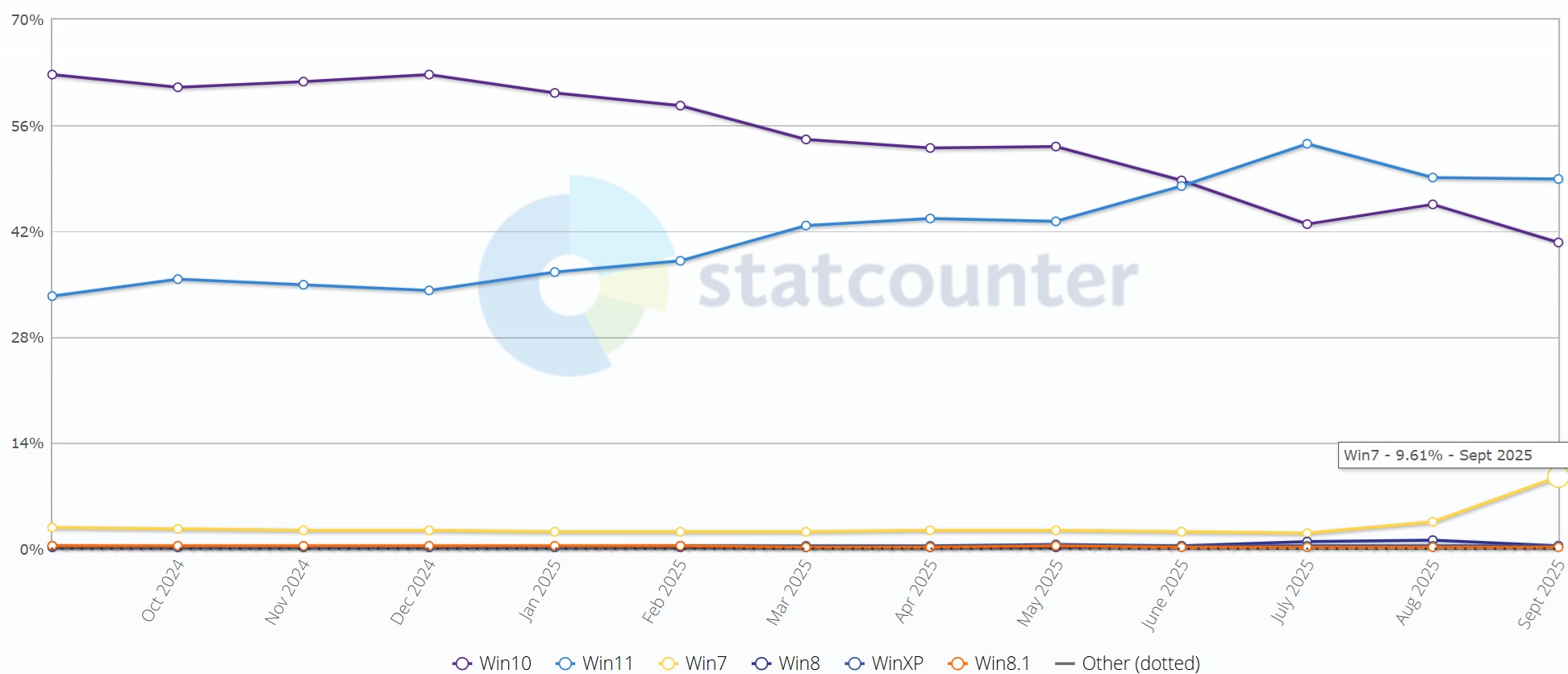
While it’s true that Windows 11 is not perfect and some users prefer older versions like Windows 7 or even Windows 98, the idea that millions are abandoning Windows 11 for decades-old systems is highly improbable.
Similar anomalies have occurred in other areas. For instance, StatCounter once reported that Google lost roughly 10 percentage points in search engine market share, which some attributed to the "ChatGPT effect." In reality, this was a reporting error, as Google had one of its best quarters during that period:
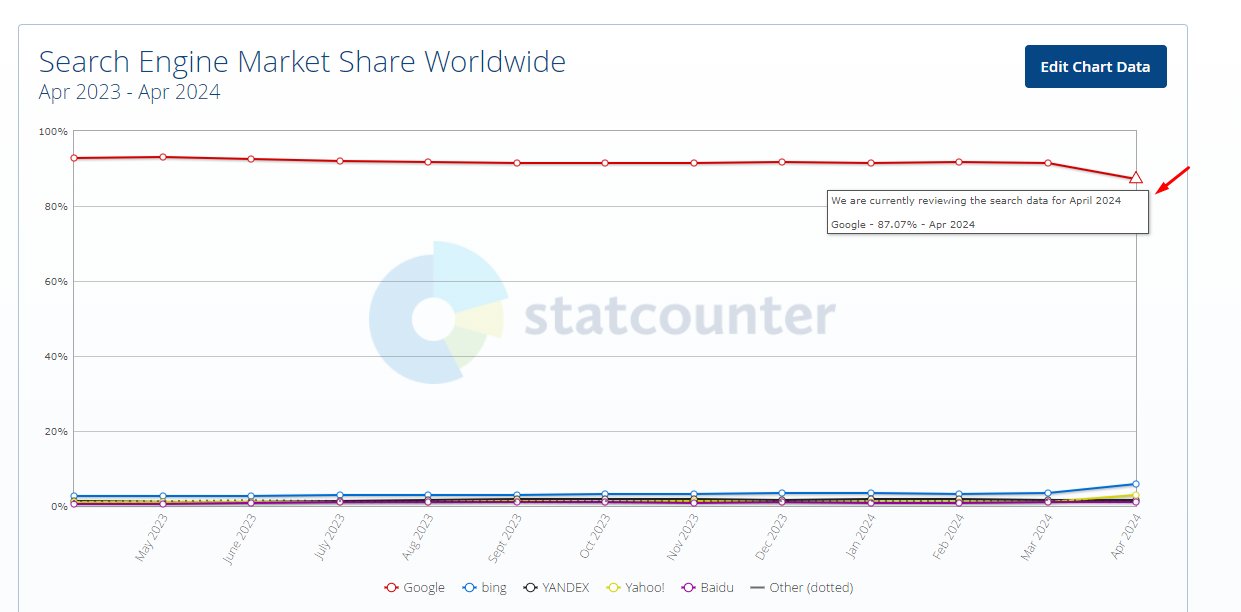
These examples highlight the importance of questioning such numbers. It’s highly unrealistic to believe that millions of users would uninstall Windows 11, revert to Windows 7, and then switch back within weeks. Similarly, it’s implausible for millions to abandon Google for ChatGPT and then return immediately.
Cloudflare Radar Also Shows a Linux Spike, but Bots Explain It
Cloudflare Radar, a data source from one of the largest internet security and DNS providers, also recorded a Linux spike around the same time as StatCounter. Cloudflare Radar provides a breakdown of both human and bot traffic, which is useful for analyzing trends.
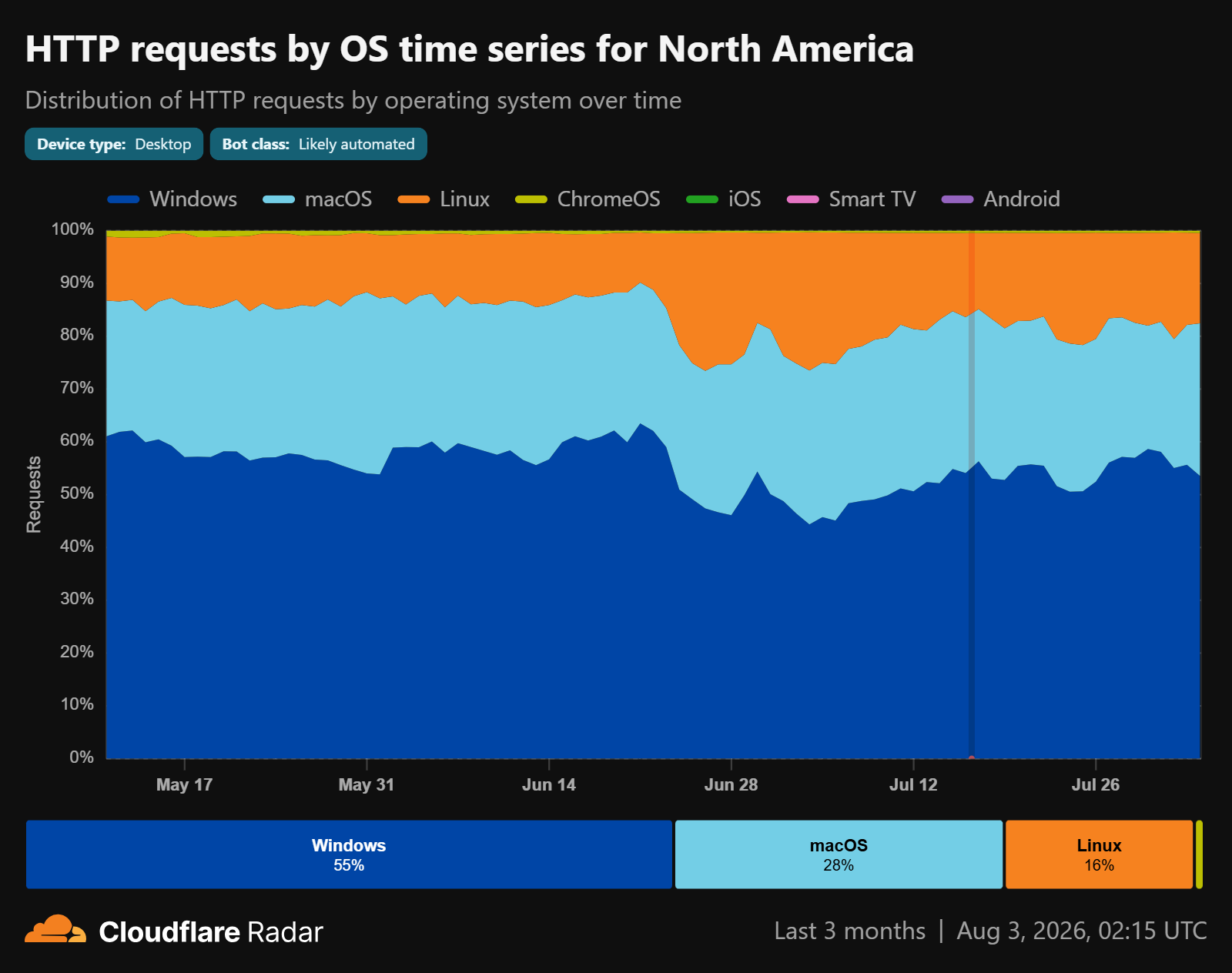
While Cloudflare’s default data for North America showed Linux at a 16% market share and Windows dropping from 65% to 55%, a closer look reveals the same issue as StatCounter: BOTS.
The Linux Surge Collapses When You Filter for Human Traffic
Cloudflare Radar enables users to filter for human-only traffic. When this filter is applied, the Linux surge disappears. A filtered view of North American desktop traffic shows Linux at approximately 4.7% over the past three months, while Windows holds at 65% and macOS at 28%.
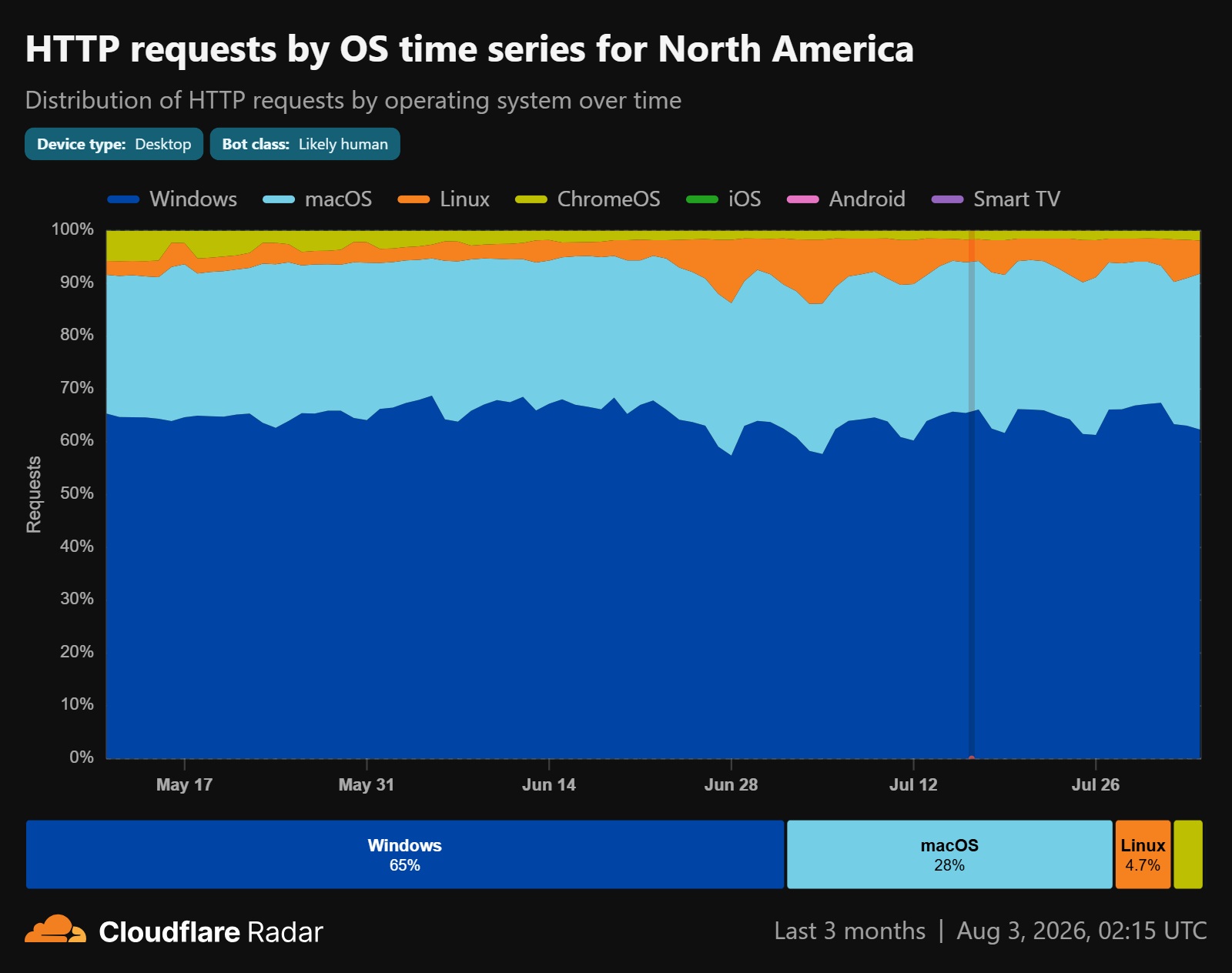
When automated traffic is included, Linux jumps to an average of 16%, spiking to as high as 26% on certain days, while Windows drops to the mid-50% range. Notably, Linux and Windows exhibit a near-perfect inverse correlation in automated traffic, with daily shares correlating at about -0.91.
It’s important to recognize that Linux is a user-installed operating system, unlike Windows or macOS, which come preinstalled on most PCs. Consumers must actively choose Linux, which is why its market share remains relatively low. The same logic applies to Android forks, which also have limited market share due to the need for manual installation.
Linux is a Great Platform, but Misleading Numbers Hurt Its Credibility
This article is not intended to diminish Linux. In fact, Linux is an incredible operating system that powers this website’s server. Even MS supports Linux with its own distribution and contributes significantly to open-source software.
However, backing misleading claims does not benefit the Linux community. It’s time to stop believing these viral numbers, as they often originate from misinterpreted data and are not designed for market share analysis. The real concern here is the rise of bot traffic, which distorts the data and fuels unnecessary debates in the “Windows vs. Linux vs. macOS” rivalry.
Windows Latest depends on readers like you. Make us your preferred source on Google Discover and Google Search to help our independent reporting reach more people.